


I became a horror fan very early in my life; and like most budding perusers of the perverse, I found my roots in the dark and dusty corners of my elementary school library. Books in the K-6 halls are not policed as well as some helicopter parents might wish to think they are, and though the more explicit fare like that of Stephen King had to come from an internal source (thanks, Dad) I did find an introduction to the terrifying through the works of Edgar Allan Poe and R.L. Stine. Amongst the likes of these beginner’s nightmares was a particular book series that nearly every fan of the macabre, young and old, knows: Scary Stories to Tell in the Dark.
The stories contained within the three volumes are nothing terribly special; the books are collections of myths and urban legends, most of which are more silly than scary. What made these books memorable, however, are the illustrations by artist Stephen Gammell: the pages are filled with gruesome sketches of corpses and gore, both beautiful and nightmarish at once. As a child, I gobbled up the tales and drawings, and always tried to bust them out at sleepovers (Though nobody else ever wanted to listen or pour over them with me.)
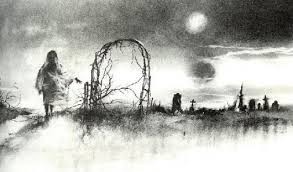
Flash Forward to 2019: A film based on these stories is announced. My initial thoughts were skeptical: these tales have no cohesive line of storytelling. What was the point of this, except maybe to bang the collective nostalgia button of a generation for profit? When the trailer dropped though, my skepticism immediately turned to optimistic curiosity.
Flash forward to 2022: Extremely late to the party, I see an article about the film adaptation of Scary Stories to Tell in the Dark, and remember it was finally put back on Netflix. Finally, I get around to seeing it. Was it worth the wait? In short, yes.
Warning: Minor spoilers.
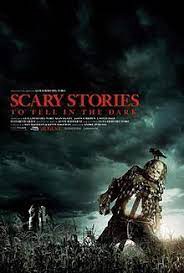
Written by Guillermo Del Toro and brother Kevin and Dan Hageman, Scary Stories takes place in a small, probably midwestern town in 1968. Visually, the film is stunning. Director André Øvredal uses a multitude of bright pastels against a stark backdrop of blacks and grays: the result is a decidedly Fall aesthetic. This is a film made for Halloween; the vibe that Scary Stories is striving for would not feel at home when viewing any other time of year.
August, Chuck, and Stella are three best friends determined to get the most out of their last Halloween as they reach their teenage years. The trio has been tortured by local bully Tommy Milner for some time, and they decide to use Halloween night to retaliate. After pranking Tommy and hiding out in the car of a young drifter named Ramón, the group makes their way to the local haunted house: Bellows Mansion. According to legend, Sarah Bellows was locked away by her family, her only link to the outside world a thin wall through which she would tell local children ghost stories. There, Tommy locks them up in the basement and leaves them to their fates, but after Stella opens a book of Sarah’s scary stories that she finds on a shelf, they are mysteriously set free. The story, though, is just beginning, as the book seems to tell its own stories without the need for a writer.
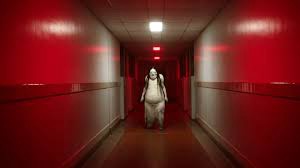
I cannot stress enough how much the jarring visuals make this film: The animated renditions of the classic artwork is arguably the entire point of the movie. With a PG-13 rating, I was unsure of what to suspect. You can only get away with so much, after all. Scary Stories pushes the boundaries of that rating as the illustrations of the books come to life in horrifying detail, while cleverly implying gore without having to show it. Not to mention, the timing of their few allotted swear words is impeccable. As each story is written into the book, the body count climbs surprisingly high, with main characters biting the dust often and early. Though becoming more common with series like Stranger Things and The Midnight Club, the darker tones laid over the “Group of Kids on a Coming-of-Age Adventure” trope is still a little surprising at first. In this case, I felt a striking resemblance to the original It miniseries from 1990; without giving the plot away, something about the small-town with a horrible secret dynamic ties these two together in my mind.
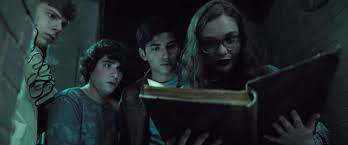
The acting is decidedly all over the board; while most performances are aggressively average, the dichotomy between Zoe Colleti’s Stella and her father, played by Breaking Bad’s Dean Norris, is surprisingly poignant. In contrast, I can’t tell if Austin Abrams is phoning in his portrayal of bully Tommy Milner, or if he is intentionally playing a kid who just really wants to be a creepy James Dean. Either way, it didn’t work for me. It does little to lessen the entertainment value of the total product, however.
Though the plot is straightforward, that works to the film’s advantage. At the center of it, Scary Stories is a ghost story, and the best ghost stories are the simple ones. They exist more to evoke a certain feeling. There are times when the film does try to be more than it is designed to be, however. The heavy topics being discussed in the background of the movie often feel unnatural. Interspersed between the story is footage of the lead up to Nixon’s Presidential election, as well as ham-fisted, unnecessary attempts at commentary on race relations and the Vietnam War. While these topics are important to explore and should be talked about honestly and openly in film, they feel out of place in Scary Stories. Any potential is stifled by mentioning these topics offhandedly and then leaving them unexamined. Mostly, these elements seem to exist only to set the time period.
Outside of that, though, Scary Stories to Tell in the Dark delivers on its key point of appeal: it is a film that is trying to catch the spirit of the spookiest time of year and the tales that it inspires. It achieves this and then some, and is truly a movie of the season. Surprisingly bleak, this is a great transitional horror flick for the younger generation of ghouls out there, as well as one that all fans of the macabre can enjoy. The ending is a cheap set up for a sequel, which was disappointing; however said sequel was just announced this year. If they can deliver the same dread-inducing visuals while tightening up the storytelling, Scary Stories to Tell in the Dark may soon refer to both a beloved book trilogy and movie franchise. For now though, the first film is a solid recommendation to anyone looking for a movie to get you into the Halloween Spirit.
 Welcome to the online portfolio of Tilsen Mulalley.
Leave a comment