


More than anything else, the Slasher film is a vibe. It’s its own aesthetic, with an air about it that distinguishes a quality film of the genre from a bad one. This mood, if you will, is extremely important, as the normal rules of good and bad movies do not apply to this subgenre of horror. Plot, writing, and acting, while still exerting some control over the quality of the film, take a backseat to the trashy, nostalgic, neon-lit atmosphere of the Slasher. It is a formula both simple and complicated; a ratio of few ingredients that must be mixed correctly if the movie is to succeed. Unfortunately, the horror landscape today is littered with films that just miss the mark: They either shoot for realistic, grisly tones that quickly become torture-porn, or they try to make a film deeper than the proverbial pool of the Slasher was ever meant to go. The Terrifier films, while not perfect, have recently become notable exceptions to the majority, however.
I decided to talk about these two movies together because now that both are on the market and with Terrifier 2 shaping up to be one of the biggest horror successes of 2022, it wouldn’t make any sense to review them separately. Additionally, talking about both films at the same time allows us to really see the evolution of Damien Leone as a filmmaker.
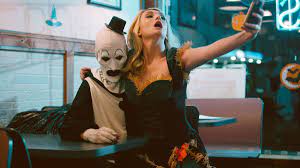
Terrifier, released in 2016, thrives throughout its runtime on aesthetic and vibe alone. The camera work and lighting are reminiscent of the 1980s, utilizing darkness and grain and reveling in imperfection. It feels as though it is utilizing the filters used on Grindhouse homages like Death Proof without being too heavy handed with it. The result is a more realistic representation of the visual quality of horror films forty years ago, and it is a joy to look at. Draped over Terrifier’s modern setting, this cheap, basic film style born of necessity nearly half a century ago proves itself to be not only still viable, but visually appealing in modern cinema. Paired with a dissonant, at times synthy soundtrack and loads of wonderfully garish practical effects, Terrifier will scratch the itch of any genre fan looking to set the appropriate mood.
The plot is nearly non-existent beyond a basic premise of a group of people all in the wrong place at the wrong time, and feels like an elongated vignette. The acting is amateurish at best, which I think actually works in the film’s favor. Still, it does feel shallower than need be at times, and a little bit more backstory or introspective into the characters, particularly Art the Clown, would have been appreciated.

Speaking of Art, I found myself to be disappointed with him, given the recent excitement behind these movies. Though memorable, something about him just doesn’t feel… finished, and I think that it really has to do with the minimal amount of backstory concerning his character. His mime-visage is unsettling, and his mannerisms are played well, yet I couldn’t help but feel throughout the film that he was a reskinned, silent Freddy Krueger. That’s not a bad thing by any means, but it doesn’t feel as though he reached his full potential.
One thing that did not disappoint though, were the practical effects used throughout the film, particularly the kill scenes. They are intense, and the word bloodbath may be an understatement when describing these movies. A particular scene involving a hacksaw and a very unfortunate woman was the proverbial candle on top of this bloody, bloody cake.
At this point, would like to say that I do take umbrage with something here: there has been some talk concerning both films and the level of violence portrayed. While both films are undoubtedly over-the-top and not for the squeamish, a distinction should be made between these and other recent horror fare in terms of gore. While many films with a focus on violent themes tend to model their effects in a realistic, stomach-turning way, Terrifier does the opposite, offering mannequins with peeling latex skin drenched in technicolor blood and model heads being filled with bullets. It’s revolting, yes, but its not realistic. Its so grotesquely high-volume as to be laughable, which is where a large degree of the trashy nostalgic mood these movies set out to achieve comes from; imagine a haunted house attraction if all of the rubber guts and fake blood suddenly became real. It’s fantastic, and it is definitely the reason that Terrifier succeeds, despite being pulled down by several weak points.

Though played as a sequel, In many ways, Terrifier 2 feels like a more realized and formed version of the first film. I can’t help but draw parallels to Sam Raimi and his use of a larger budget on Evil Dead 2 to make the movie he’d wanted to make with the original; one definitely gets the idea that director Damien Leone had the same thought process.
Picking up directly after the events of the first film before quickly cutting to a year later, Terrifier 2 is an improvement in almost every way over its predecessor. The plot, while still thin, is tangible this time, and the characters have just enough depth and personality that we begin to sort of care about what happens to them. Unfortunately, Art still feels hollow, and a surreal dream sequence that conjures up real life consequences doesn’t help the Freddy Krueger comparisons. The film does pay homage to Nightmare on Elm Street, as well as several other franchises with subtle little nods, but without concretely giving Art his own identity as a villain, it feels as though it could veer into parody at any moment.
Terrifer 2 does not disappoint, however, despite these shortcomings. The sequel goes even further with its FX work, with Leone actually raising a large amount of money from fundraising websites to ensure a sizable budget for the makeup and special effects of the film, as well as being able to afford an extremely fun cameo appearance by a vetted and approved Slasher Queen that will be a familiar face to any fan. This dedication shows in the array of creative, deadly, and more numerous antics Art gets up to this time around. The gore and complexity of the special effects easily tops the original, the controversial hacksaw moment of the first film being blown away by a grotesque, hilariously bloated mutilation scene that lasts nearly three minutes. I will not spoil it here, but it is so over-the-top that I found myself laughing hysterically by the end of it.
One does get the impression that Terrifier 2 is trying to do too much, though. At over two hours, the film begins to drag in the falling action, devolving into a series of false starts that get boring quickly. The storyline also becomes a muddled mess by the resolution, introducing psychic connection plot points that go nowhere (though they do leave everything open for a sequel.) By the final minutes, the once thin plot feels like a mishmash of ideas, and the sudden, abrupt ending does nothing to remedy this before the credits roll. While this might be a comedic allusion to other genre films guilty of the same thing, It doesn’t come across as a joke to me. What this movie lacks in storytelling ability though, it makes up for in pure, bloodsoaked fun, just like its predecessor.
Despite their imperfections, Damien Leone has captured the elusive magic of this once niche genre and brought it back to the silver screen with the Terrifier films. He recycles tropes, music, lighting and camera techniques of a past generation of movies and applies them to a modern setting with great success. As I said before, the Slasher is a vibe, and The Terrifier series passes the check easily.
 Welcome to the online portfolio of Tilsen Mulalley.
Leave a comment